

Публикации по производству
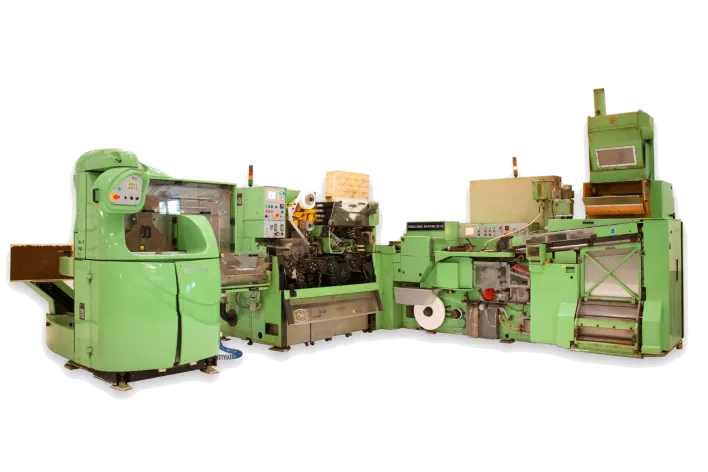
The choice between the Molins Mark 8 and the Molins Mark 9 is not really a question of which machine is better. It is a question of which machine is right for where you are in your production journey. Both machines are proven. Both are available. Both carry decades of engineering refinement from the same British manufacturer. The difference between them is a difference in output capacity, automation level and operational complexity that maps directly onto the production volume requirements of the manufacturers who should be running each one.
This article works through the comparison directly, covering the specifications that define each machine’s production ceiling, the operational differences that affect your team and your maintenance programme, and the decision framework for choosing between them based on your actual production volume requirements.
The Specifications That Define the Comparison
Before the decision framework, the numbers. The Mark 8 and Mark 9 are separated by a specific set of specifications that translate directly into production output and operational requirements.
Он Марк 8D MAX 15 operates at 3,000 cigarettes per minute. It runs on 17kW and weighs 5,000kg. Its machine unit consists of the MK-8D cigarette maker with the MAX-15 filter assembly and 1117 infeed unit. It handles all commercial formats: king-size, demi, slim, super slim and nano, across circumferences from 17mm to 28.3mm and lengths from 65mm to 110mm. It is a cast iron machine in the core Mark 8 engineering tradition.
Он Марк 9 МАКС С operates at 4,500 to 5,000 cigarettes per minute. It weighs 7,800kg with a maximum dimension of 3,600mm. Its filter assembly is the Hauni MAX S filter assembler with mass flow tray filler. It covers the same format range as the Mark 8 across circumferences from 17mm to 28.3mm and lengths from 65mm to 110mm. It carries a documented maintenance interval of 2,000 to 3,000 operational hours. It is built in stainless steel and is fully automatic.
These two specifications define two genuinely different production machines, not two versions of the same machine running at different speeds.
Production Volume: The Primary Decision Driver
The most direct comparison is output per shift. Working from the headline CPM figures:
- Mark 8D MAX 15 at 3,000 CPM, single 8-hour shift: approximately 1.44 million cigarettes per shift, or 4.32 million per day on three shifts
- Mark 9 MAX S at 5,000 CPM, single 8-hour shift: approximately 2.4 million cigarettes per shift, or 7.2 million per day on three shifts
The Mark 9 produces approximately 67 percent more cigarettes per shift than the Mark 8 at its rated outputs. Per month across 25 production days at three shifts, the Mark 8 delivers around 108 million cigarettes from one machine. The Mark 9 delivers around 180 million. That 72 million cigarette monthly difference is the volume gap that defines which machine belongs on your production floor.
If your production requirement falls comfortably within the Mark 8’s ceiling, the Mark 9’s additional capacity is unused capital. If your requirement approaches or exceeds the Mark 8’s ceiling, the Mark 9 is not a step-up option. It is a necessity.
The Cast Iron and Stainless Steel Difference
Он Марк 8 Пост 64 and Mark 8D both use cast iron construction in the machine body. The Mark 9 MAX S is built in stainless steel. This is not incidental. It reflects a different manufacturing era and a different engineering approach to precision at higher production speeds.
Cast iron is exceptionally stable dimensionally. Once machined and run in, a cast iron machine frame holds its geometry over very long operational periods. This is why Mark 8 machines continue to run reliably decades after manufacture. The structural integrity of the cast iron body does not degrade under normal production loads. This is the engineering foundation behind the Mark 8’s longevity and its reputation among operators as a machine that works.
Stainless steel brings a different set of advantages at the Mark 9’s higher operational speed. It provides better hygiene characteristics, greater resistance to tobacco acid and moisture exposure, and the precision surface finishing that high-speed automated systems require for consistent component alignment. At 5,000 CPM, the machine is executing mechanical cycles significantly faster than the Mark 8, and the tighter tolerances required for consistent product quality at this speed are better maintained in stainless steel construction over the machine’s operational life.
The material difference is not a quality argument for either machine. It is an engineering match between the construction approach and the production speed the machine is designed to sustain.
Automation Level: MAX 15 vs MAX S Filter Assembly
The filter assembly system is where the automation difference between the two generations is most visible on the production floor.
The Mark 8D MAX 15 uses the MAX-15 filter assembler with 1117 infeed unit. This is a capable and reliable filter attachment system that provides automated filter supply and attachment at the Mark 8’s operating speed. It represented a meaningful automation step up from the earlier Mark 8 Post 64 configuration with its Hauni Max 3 system, and it serves the Mark 8’s 3,000 CPM output without becoming a throughput constraint.
The Mark 9 MAX S uses the Hauni MAX S filter assembler with mass flow tray filler. The mass flow system controls tobacco feed rate with a precision that the older infeed systems cannot match, and at 5,000 CPM this precision is operationally significant. Inconsistent tobacco feed at the Mark 9’s speed produces rod weight variation that compounds into quality problems faster than at lower speed, because the machine is producing more cigarettes per minute that carry any given process variation. The MAX S mass flow system addresses this by maintaining feed rate accuracy as an active, real-time function rather than relying on gravity-fed or mechanically metered tobacco supply.
The practical consequence on the production floor is that the Mark 9 requires less operator intervention to maintain consistent rod weight than the Mark 8, because the automated feed control is managing a variable that the Mark 8 operator handles more manually. For facilities with experienced operators and lower production volumes, this distinction is less significant. For facilities running three shifts at high volumes with variable operator experience levels across shifts, it is a meaningful production quality advantage.
Maintenance Intervals: What the Numbers Mean in Practice
The Mark 9 MAX S carries a documented maintenance interval of 2,000 to 3,000 operational hours. This figure does not have a direct published equivalent for the Mark 8, whose maintenance profile is more condition-based than interval-based given its mechanical simplicity and the well-established wear patterns of its key consumables.
What the Mark 9’s 2,000 to 3,000 hour interval means in practice is that the machine is engineered for extended production periods between major service events. At two 8-hour shifts per day, 5 days per week, the lower end of this interval is approximately 25 weeks of operation between major maintenance events. This is a significant operational advantage for facilities where production scheduling flexibility is limited and planned downtime windows are difficult to create frequently.
The Mark 8’s maintenance is more frequent for its consumable components, particularly garniture tapes and suction tapes, but each individual maintenance event is shorter and less complex than the Mark 9’s major service given the Mark 8’s simpler mechanical architecture. The total annual maintenance time across both machines may be comparable when the cumulative impact of the Mark 8’s more frequent but shorter interventions is compared against the Mark 9’s less frequent but more involved service events. The difference is in the planning requirement: the Mark 9 demands careful advance planning for its service windows, while the Mark 8’s maintenance is more continuous and integrated into routine operations.
Запасные части для Molins Mark 8 и Запасные части для Molins Mark 9 are both available through established supply channels, with the Mark 8 parts ecosystem being more mature given the machine’s longer production history. For facilities new to either machine, confirming parts availability for their specific configuration before purchase is the appropriate due diligence step.
Capital Cost and Total Cost of Ownership
The Mark 9 carries a higher purchase price than the Mark 8. This is expected given the output difference, the higher specification and the more complex engineering. The relevant comparison for an investment decision is not purchase price alone but the cost per cigarette produced over the machine’s operational life, which accounts for purchase price, installation, maintenance, energy consumption and operational labour across the full production horizon.
At the Mark 9’s 5,000 CPM output, the capital cost per cigarette produced over a ten-year operational period is lower than for the Mark 8 at 3,000 CPM, assuming the Mark 9 is running at sufficient utilisation to justify its capacity. This is the critical qualifier. A Mark 9 running at 50 percent utilisation because production volume does not demand its full capacity has a worse cost-per-cigarette profile than a Mark 8 running at 90 percent utilisation matched to its actual volume. Capital efficiency depends on utilisation, and the machine that is well-matched to your production volume will almost always deliver better cost-per-cigarette economics than a higher-specification machine running under-utilised.
The energy consumption difference is also relevant over a ten-year operational horizon. The Mark 9 uses more power than the Mark 8 at 17kW, but its higher output per hour means the energy cost per thousand cigarettes produced may be comparable or lower than the Mark 8 depending on the specific operational parameters. This is worth calculating explicitly for your production environment rather than assuming that lower power consumption on the Mark 8 translates to lower energy cost per unit of output.
The Transition Point: When Mark 8 Output Becomes Insufficient
Every Mark 9 operator was at some point either a Mark 8 operator whose volume grew beyond the Mark 8’s ceiling, or a new entrant who correctly assessed their target volume as requiring the Mark 9 from the outset. Understanding the transition point helps both groups make the right decision at the right time.
The operational indicators that a Mark 8 operation has reached its ceiling include running the machine at maximum speed across all three shifts with no capacity buffer for format changes, maintenance stops or volume peaks, sustained order backlogs that cannot be resolved through scheduling optimisation, and a production cost structure that increasingly reflects the labour and maintenance overhead of a machine running near its ceiling rather than the economics of a machine matched to volume. When two or more of these indicators are present simultaneously and consistently, the case for transitioning to a Mark 9 is typically clear.
The transition from Mark 8 to Mark 9 is operationally logical rather than disruptive for most facilities. The two machines share the Molins engineering philosophy, which means operator familiarity with the Mark 8 transfers to the Mark 9 more readily than a transition between different OEMs would require. The garniture tape, suction tape and cutting knife knowledge from the Mark 8 applies to understanding the equivalent maintenance requirements on the Mark 9. The кормушка для табака and upstream processing equipment can typically be retained when upgrading from Mark 8 to Mark 9, with only the making machine and filter attachment section changing.
Who Should Choose the Mark 8
The Mark 8 in either the Post 64 или Марк 8D MAX 15 configuration is the right choice for manufacturers whose production volume falls within the 3,000 CPM output ceiling, who are at the growth stage of their production journey and value operational simplicity alongside reliable output, who are building technical capability in their maintenance team alongside building production volume, and who want to establish market position before committing to the higher capital requirement of the Mark 9.
It is also the right choice for manufacturers whose volume projection does not confidently exceed the Mark 8’s ceiling within a three to five year horizon, where investing in Mark 9 capacity at this stage would mean running the machine at low utilisation for an extended period before the volume justification catches up with the capital investment.
Who Should Choose the Mark 9
Он Марк 9 МАКС С is the right choice for manufacturers whose production volume requires output above what the Mark 8 can sustainably deliver, who are supplying commercial customers with contracted volumes that require the Mark 9’s throughput consistency, who have experienced technical staff capable of operating and maintaining a more sophisticated automated system, and who are building a production line for the medium to long term rather than the early growth phase.
It is also the right choice for manufacturers who are entering the market at scale rather than growing into scale, where the production requirement is established from the outset as a mid-level commercial volume that a Mark 8 would need to be run at or near its ceiling to meet.
Beyond the Mark 9: The Mark 9.5
For manufacturers whose volume ambitions extend beyond the Mark 9 MAX S, the Марк 9.5 МАКС S и Сервоприводы Mark 9.5 Lenze represent the premium tier of the MOLINS platform. These machines build on the Mark 9 engineering foundation with enhanced control systems, higher output ceilings and, in the Lenze Servo Drives variant, precision servo-controlled motion architecture throughout the machine’s drive system. The progression from Mark 8 through Mark 9 to Mark 9.5 is a coherent engineering path where each step builds on the previous platform’s operating knowledge and spare parts ecosystem.
Used Market Availability for Both Generations
Both the Mark 8 and Mark 9 have strong representation in the used cigarette making machine market. The Mark 8’s long production history means verified used examples are widely available across both Post 64 and MAX 15 configurations. Used Mark 9 machines are similarly available and represent a lower capital entry point to Mark 9 output capacity for manufacturers where the volume justification is present but the capital budget for new equipment is constrained. Sourcing from a supplier who verifies machine condition before sale is the critical variable in either case, regardless of which generation you are targeting.
Ознакомьтесь с полным ассортиментом машины для производства сигарет across the Mark 8, Mark 9 and Mark 9.5 generations and the машины для производства фильтров that complete each line configuration before finalising your production line specification.
FAQs: Mark 8 vs Mark 9 Cigarette Making Machine
What is the main production speed difference between the Mark 8 and Mark 9?
The Mark 8D MAX 15 operates at 3,000 cigarettes per minute. The Mark 9 MAX S operates at 4,500 to 5,000 cigarettes per minute. This represents a production speed advantage of approximately 50 to 67 percent for the Mark 9 over the Mark 8 at their respective rated outputs. In practical terms, a Mark 9 running a full three-shift day produces approximately 7.2 million cigarettes compared to the Mark 8’s 4.32 million at rated speed, a difference of approximately 72 million cigarettes per month across 25 production days.
Can a manufacturer run the same cigarette formats on both the Mark 8 and Mark 9?
Yes. Both machines cover the same commercial format range: king-size, demi, slim, super slim and nano, across circumferences from 17mm to 28.3mm and lengths from 65mm to 110mm. Format changes on either machine require the appropriate tooling changes to the garniture and filter attachment section. The format range is not a differentiating factor between the two generations. The differentiating factors are production speed, automation level, filter attachment system and maintenance interval.
How does the filter attachment system differ between the Mark 8 and Mark 9?
The Mark 8D MAX 15 uses the MAX-15 filter assembler with 1117 infeed unit. The Mark 9 MAX S uses the Hauni MAX S filter assembler with mass flow tray filler. The mass flow system on the Mark 9 provides more precise, real-time control over tobacco feed rate than the Mark 8’s infeed system, which is operationally significant at the Mark 9’s higher production speed. At 5,000 CPM, feed rate variation produces quality consequences faster and across a higher volume of cigarettes than at 3,000 CPM. The Mark 9’s mass flow system manages this variable actively, reducing the rod weight variation that would otherwise result from feed rate inconsistency at high speed.
Is the Mark 8 easier to maintain than the Mark 9?
The Mark 8’s cast iron construction and mechanically direct design make individual maintenance events straightforward and accessible. Its key consumables, garniture tapes, suction tapes, cutting knives and hopper feeders, are replaced frequently but quickly by operators familiar with the machine. The Mark 9 has longer maintenance intervals of 2,000 to 3,000 operational hours, meaning major service events are less frequent, but each event is more involved than a typical Mark 8 maintenance stop given the Mark 9’s higher specification. Neither machine is more difficult to maintain in total. They have different maintenance patterns: the Mark 8 requires more frequent but shorter interventions, the Mark 9 requires less frequent but more planned service events.
Should a new tobacco manufacturer start with the Mark 8 or go directly to the Mark 9?
The right starting point depends on your production volume projection, not on which machine is technically superior. A new manufacturer with a clear commercial volume requirement that falls within the Mark 9’s output range and the capital to support it should start with the Mark 9 rather than constraining their operation to the Mark 8’s ceiling from day one. A manufacturer whose initial volume is genuinely within the Mark 8’s output range should start with the Mark 8, establish their production and quality processes on a machine whose operational simplicity supports team capability building, and upgrade to the Mark 9 when volume growth justifies it. The Molins platform’s consistency across generations makes this progression operationally smooth.
 Russian
 English
 Turkish
 Polish
 Ukrainian
 Belarusian
 Bulgarian
 Indonesian
 German